
RULES & POSITIONS OF FOOTBALL
What are the rules and positions in football, and do they change per age group?
POSITIONS IN FOOTBALL
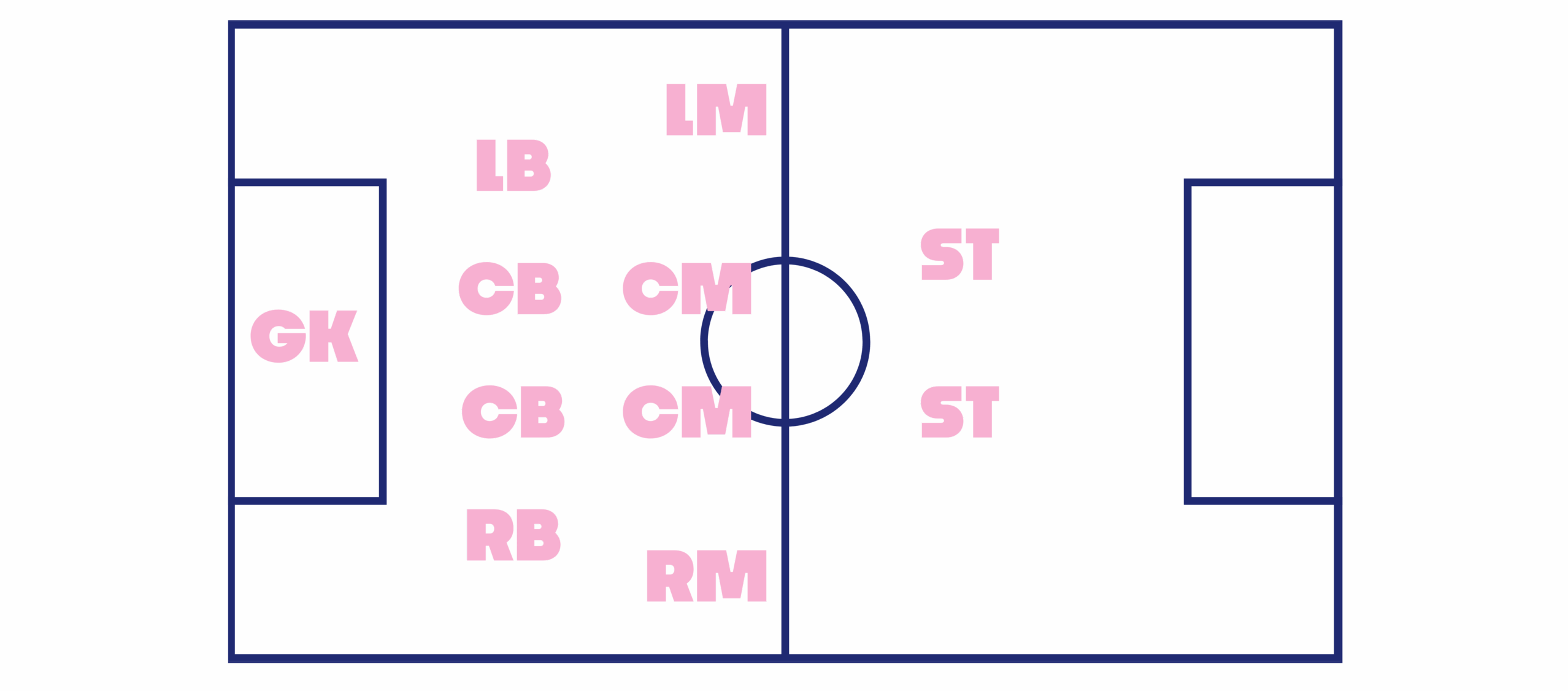
Goalkeeper (GK)
-
Where they play: In and around the goal, inside the penalty area.
-
Role: The last line of defence – stops shots, catches crosses, and organises defenders.
-
Skills needed: Quick reflexes, safe handling, good communication, bravery, and confidence using their hands and feet.
Defenders (DF)
-
Where they play: Closest to their own goal, mainly in the defensive third.
-
Role: Their job is to protect the goalkeeper, block attackers, win tackles, and clear the ball. Defenders in the middle are called Centre Backs (CBs) – strong in the air and good at marking strikers. Defenders on the sides are called Right Back (RB) and Left Back (LB) – they defend against wide players but also support attacks by overlapping and crossing.
-
Skills needed: Strong tackling, heading, positioning, awareness, and the ability to stay calm under pressure.
Midfielders (MF)
-
Where they play: Mostly in the middle third of the pitch, but they cover a lot of ground linking defence and attack.
-
Role: They control possession, pass the ball, and create chances. Central Midfielders (CMs) link play and often dictate the game. Wide midfielders like Left Midfield (LM) and Right Midfield (RM) stay closer to the sidelines, providing crosses and supporting wingers/strikers. Midfielders may be defensive (breaking up attacks) or attacking (supporting strikers).
-
Skills needed: Good passing range, vision, stamina, close control, and smart decision-making.
Striker/Forward (ST)
-
Where they play: Furthest forward, in the attacking third near the opponent’s goal.
-
Role: The main goal-scorer. Strikers find space, make runs behind defenders, and finish chances. They may play as a “target man” holding up the ball or as a quicker forward who runs onto passes.
-
Skills needed: Clinical finishing, movement off the ball, pace, strength, and confidence in front of goal.

FOOTBALL AGE GROUPS
Under 7 & Under 8
-
Format: 5-a-side. Ball Size 3. Pitch size 30×20.
-
Game time: 4 × 10 min or 2 × 20 min (max 40 mins total)
-
Positions: GK + 2 defenders + 1 midfielder + 1 striker (players rotate often).
Under 9 & Under 10
-
Format: 7-a-side. Ball Size 3. Pitch size 60×40.
-
Game time: 2 × 25 min (max 50 mins total)
-
Positions: GK, defenders (CB + RB/LB), midfielders (CM/LM/RM), and striker(s).
Under 11 & Under 12
-
Format: 9-a-side. Ball Size 4. Pitch Size 80×50.
-
Game time: 2 × 30 min (max 60 mins total)
-
Positions: GK, 3-4 defenders (CBs + FBs), 3-4 midfielders (CM/LM/RM/AM/DM), and striker(s)
Under 13 & Under 14
-
Format: 11-a-side. Ball Size 4. Pitch Size 90-100×55-65
-
Game time: 2 × 35 min (max 70 mins total)
-
Positions: Full standard 11-a-side: GK, RB, LB, CBs, midfielders (CM/LM/RM, or attacking/defensive), and forwards/wingers.
Under 15 & Under 16
-
Format: 11-a-side. Ball Size 5. Full size pitch.
-
Game time: 2 × 40 min (max 80 mins total)
-
Positions: Standard 11-a-side positions. Teams start using more tactical systems (4-3-3, 4-4-2, etc.).
Under 17+
-
Format: 11-a-side. Ball Size 5. Full size pitch.
-
Game time: 2 × 45 min (max 90 mins total, full adult match length)
-
Positions: Full adult roles, tactical formations.
Girls & Boys Football
-
U7–U18: Boys and girls can play mixed football on the same team and in the same league all the way up to under-18s.
-
From around U10 upwards, there are girls-only teams and leagues available.
-
Many girls play mixed at younger ages, then switch to girls-only football when they want to (especially if playing at a higher competitive level).
RULES IN FOOTBALL
The aim of football is to score more goals than the opposing team.
1. Match Basics
-
A game is played in two halves, with the time varying in each different age group.
- There can be between 5-11 players per team on pitch.
- The game starts (and restarts after a goal/half-time) with a kick-off from the centre circle.
-
The ball is in play unless it fully crosses the touchline or goal line.
2. Age Group Specific Rules
-
Heading the ball: In England, heading is banned in training for U11s and below, and restricted for U12–U16 (limited heading practice only).
-
Sin bins (temporary dismissals): Used in youth football for dissent.
-
Equal playing time: FA encourages equal time on pitch at U7–U11, rather than results-only focus.
- U7-U8: No offside rule. Roll on/off subs encouraged. No set positions.
- U9-U10: Introduce offside rule. Throw-ins, corners, free kicks, penalties all now used. Roll on/off subs still encouraged.
- U11-U12: Full FA Laws of the Game mostly apply. GK distribution (kick or throw) allowed. Still roll-on/roll-off substitutions.
3. Scoring Goals
-
A goal counts when the whole ball crosses the goal line, between the posts and under the crossbar.
4. Player Roles
-
Goalkeeper: Only player who can use hands, and only inside their penalty area.
-
Outfield players: Use feet, head, or body (but not arms/hands).
5. Key Rules
-
Kick-offs, free kicks, goal kicks, and corners: Ball must be still before kicking. Opponents stay back at least 9m (10 yards).
-
Throw-ins: Both feet on or behind the line, throw with both hands from behind the head.
-
Goal kicks: Taken from anywhere inside the penalty area. The ball is in play once it is kicked and clearly moves.
-
Corner kicks: Taken from the corner arc. Opponents must stay 9m away.
-
Drop ball: Used when play stops for reasons not caused by a foul.
6. Offside
-
A player is offside if they are closer to the opponent’s goal than the second-last defender when the ball is passed to them (unless they’re in their own half, or level with the defender).
7. Fouls & Fair Play
-
Fouls include: tripping, pushing, pulling shirts, handball (except goalkeeper in their box), dangerous play, or tackling from behind.
-
Free kicks: Awarded for fouls outside the penalty area.
-
Penalty kicks: Given if a foul happens inside the penalty area.
-
Discipline: Referees can give a yellow card (warning) or a red card (sent off) for serious fouls or bad behaviour.
8. Goalkeeper Rules
-
Has about 6 seconds to release the ball when holding it.
-
Cannot handle the ball if a teammate deliberately kicks it back to them with their foot.
9. Substitutions
-
Players can be swapped during breaks in play with the referee’s permission. Specific substitution rules apply to different age groups.
-
Number of subs allowed depends on competition rules and age category.
10. Sportsmanship
- Shaking hands before/after matches is encouraged.
- Respect referees, opponents, and teammates.
-
Play stops if the referee whistles, or if there’s an injury.